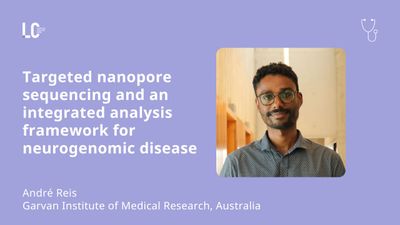
Targeted nanopore sequencing and an integrated analysis framework for neurogenomic disease | LC26
- shared.published_on: May 19 2026
Abstract
Inherited neuromuscular and neurodegenerative disorders are difficult to diagnose due to extreme phenotypic and genetic heterogeneity. Key pathogenic mechanisms, including structural variation, short-tandem repeat (STR) expansions, and D4Z4 macrosatellite contraction causing facioscapulohumeral muscular dystrophy (FSHD), are not reliably captured by existing methods. Many patients experience prolonged diagnostic odysseys and fail to receive a diagnosis from standard genetic testing. To address this, we developed a single end-to-end nanopore sequencing assay and analysis framework to detect the full spectrum of genomic and epigenomic variation implicated in neurogenomic disease. We designed Oxford Nanopore Technologies (ONT) Adaptive Sampling panels to enrich disease-associated genes and repeat loci, and applied them to 53 individuals with inherited muscle disease (myopathies) and 34 with unsolved spastic ataxia. We developed an integrated analysis framework combining small and structural variant detection (Pipeface), repeat structure and locus-specific methylation profiling of the D4Z4 macrosatellite for FSHD (d4z4ling), and scalable variant interpretation via an interactive Shiny platform (PuzzleApp). In the myopathy cohort, ONT sequencing provided new provisional genetic diagnoses in 29% of previously unsolved cases, with FSHD and oculopharyngodistal myopathies frequently missed by standard testing. In the spastic-ataxia cohort, pathogenic variants sufficient for diagnosis were identified in 41% of unsolved individuals, including STR expansions in FGF14 and RFC1, and haplotype-resolved pathogenic sequence variants in multiple genes. This talk will show that targeted ONT sequencing, coupled with integrated analytical frameworks, enables simultaneous resolution of diverse genetic and epigenetic mechanisms in neurogenomic disease and discuss the pathway to clinical implementation.
Biography
André Reis is an early-career genomics researcher in the Deveson Lab at the Garvan Institute of Medical Research in Sydney, specialising in long-read sequencing and the analysis of structural and complex genetic variation. His work focuses on developing scalable methods to integrate long-read technologies into clinical genomics, enabling improved detection of structural variants. His research is supported by a National Health and Medical Research Council (NHMRC) Ideas Grant and spans rare disease and population genomics, including Indigenous Australian cohorts.