Shearing genomic DNA using the Covaris g-TUBE™


Extraction Method
Shearing genomic DNA using the Covaris g-TUBE™
FOR RESEARCH USE ONLY.
Contents
Introduction
Materials
Method
Sequencing performance
Change log
Introduction
By default, Ligation Sequencing Kit protocols contain no designated fragmentation step. However fragmentation is optional for all users, and is recommended when working with lower amounts of input gDNA (100 ng–500 ng), where fragmentation will increase the number of DNA molecules, and therefore increase throughput. The standard Covaris g-TUBE protocol refers to using >4 µg genomic DNA. However, development work at Oxford Nanopore has shown that 100–1000 ng genomic DNA in 49 µl fragments in the same way. Oxford Nanopore routinely uses an Eppendorf 5424 microfuge at 6000 rpm to generate average Lambda DNA fragments of 8 kb. When using different genomic DNA samples, wanting different fragment sizes and using different centrifuges, optimisation of spin speeds may be required. Please refer to the g-TUBE™ literature for more details.
Materials
- gDNA in 49 µl nuclease-free water
- Covaris g-TUBE™
- Microfuge
- 1.5 ml Eppendorf DNA LoBind tubes
- DNA QC equipment, e.g. Qubit fluorometer, NanoDrop spectrophotometer, Agilent Bioanalyzer or Tapestation, Agilent FEMTO Pulse
Method
- Transfer 100 ng–1000 ng genomic DNA into a 1.5 ml Eppendorf DNA LoBind tube, and adjust the volume to 49 μl with nuclease-free water. Mix the DNA thoroughly by flicking the tube. Spin down briefly in a microfuge.
- Transfer the genomic DNA sample in 49 μl to a Covaris g-TUBE™.
- Centrifuge the g-TUBE™ for one minute at room temperature at the speed for the fragment size required. Remove and check that all the DNA has passed through the tube.
- Optional step: If DNA remains in the upper chamber, spin again for one minute at the same speed.
- Invert the g-TUBE™ and centrifuge again for one minute to collect the fragmented DNA. Remove and check that all the DNA has passed through the tube.
- Optional step: If DNA remains in the upper chamber, spin again for one minute at the same speed.
- Transfer the 49 μl fragmented DNA into a clean 1.5 ml Eppendorf DNA LoBind tube.
- Analyse 1 μl of the fragmented DNA for fragment size, quality and quantity.
Sequencing performance
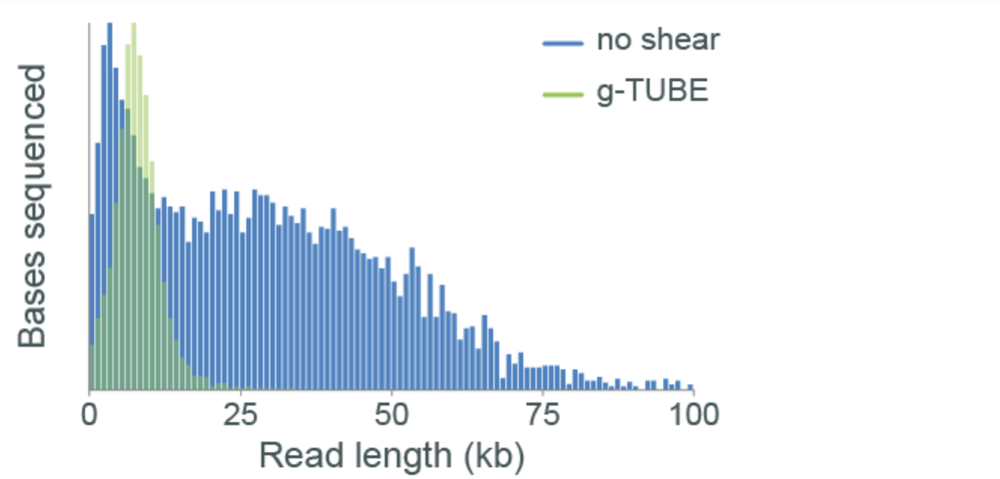
Libraries were prepared using the Ligation Sequencing Kit (SQK-LSK109).
- Read length profile:
Change log
| Version | Change |
|---|---|
| v1, September 2019 | Initial protocol publication |